FOLLOWUP: SDOT’s new option for bottom-of-hill end of Highland Park Way lane-conversion project

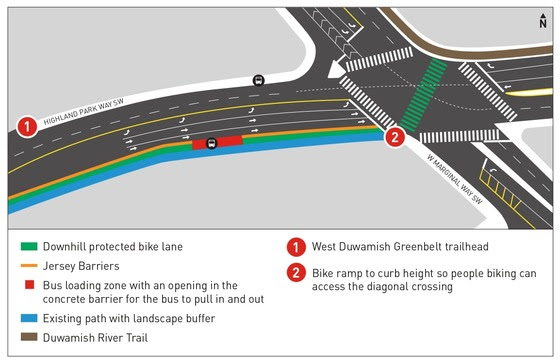
Tomorrow night, as previewed here, SDOT will be at HPAC‘s monthly meeting to talk about the Highland Park Way lane-conversion project, which would convert the outside downhill travel lane to bicycle/pedestrian space. On the eve of the meeting, they’ve just published their recap (ours is here) of their recent online meeting about the project, including a new option for the bottom-of-hill end of the project:

Introducing Option 2B: A Direct Response to Feedback

In response to feedback about wanting Highland Park Way SW to be both safer for everyone and not increase vehicle queues getting through West Marginal Way SW, our team has developed a new hybrid alternative: Option 2B.

Design features of Option 2B:

-Increased Intersection Capacity: At the bottom of the hill, the single downhill lane opens into three vehicular lanes (one left-turn lane and two through-lanes).

-Downhill Bike Lane A downhill bike lane remains protected by Jersey barriers to the intersection with West Marginal Way SW.

-Adjusted Channelization: We are removing the center median to accommodate the extra through-lane. Additionally, we are removing one of the westbound left-turn lanes at the W Marginal Way SW intersection to make space for the three eastbound vehicle lanes and the protected bike lane.

Next Steps and Feedback Opportunity

We are now evaluating three options for the intersection approach at W Marginal Way SW. You can view the trade-offs between Option 1, Option 2, and the new Option 2B on our project website.
SDOT offers three ways you can comment:

Email: HighlandHolden@seattle.gov
Hotline: 206-900-8741
Online Form: Submit your comments through the Project Feedback Form

Meantime, tomorrow’s HPAC meeting is at 6 pm (Wednesday, March 25) at Southwest Library (9010 35th SW).

49 Replies to "FOLLOWUP: SDOT's new option for bottom-of-hill end of Highland Park Way lane-conversion project"

  • Kyle March 24, 2026 (6:06 pm)

    This is the least best option. Hard to tell from the diagram, but will the light throughput be the same? E.g. the queue of two lanes is long enough to maintain the same throughput through the current green light cycle? Wish SDOT would make another survey with actual results, instead of untraceable comments.

    • K March 24, 2026 (7:04 pm)

      No, what you want is for SDOT to configure the road to your preference, regardless of the needs and safety of others.  They listened to feedback.  ALL of the feedback, not just yours.  

      • Kyle March 24, 2026 (7:57 pm)

        I’d rather they just leave the road alone, and use the median for the path all the way. 10 accidents per year is less than any other arterials leaving West Seattle. Sorry you seem to take my feedback so personal.

      • Carol March 25, 2026 (7:55 am)

        Actually they didn’t listen to the feedback if you read it…

    • Can't Stop March 24, 2026 (7:37 pm)

      How about we remove the “no turn on red” sign so the far right lane can at least move some.  That should be a concession.

      • Oof March 24, 2026 (7:53 pm)

        Right turns on red are dangerous, this would be a step backward, especially with a bike lane on the right of roadway. 

        • Kyle March 24, 2026 (8:02 pm)

          The diagram shows a diagonal bike crossing, which will stop all traffic for the bikes to cross. The no turn on red sign was added when they rechanneled the road during the pandemic to allow more cars to go straight on W Marginal Way with detour. The rechanneled left turn lanes conflicted with cars turning right on red. Now they want to take away one left turn lane, on W Marginal Way. I’d rather they demolish the raised median there that invites panhandling and is dangerous for people to stand on. If they did that the two left hand turn lanes could be kept.

      • Emily March 24, 2026 (8:29 pm)

        Currently if you are coming down the hill and take a free right- you encroach on cars coming from the south. Head on collisions happen and i STILL see people take that free right

  • CarDriver March 24, 2026 (6:19 pm)

    The fact they’re listening is encouraging. The fact that they had an original plan that they’re not committed to says they’re happy to spend our money throwing things at the wall to see if they’ll stick-and, truth be told quietly admitting their inabilities.

    • gh March 25, 2026 (9:29 am)

      “Listen to us.”

      “Okay we listened”

      “AH HA GOT YOU, the fact that you listened proved you’re incompetent.”

      Ok buddy. 

      • Jake March 25, 2026 (2:24 pm)

        Honestly, GH, SDOT knows more about traffic engineering than the general public who does not have access to the skillset and dataset required to determine such things. 

  • Concerned driver March 24, 2026 (9:46 pm)

    Does anybody know how wide the downhill lanes are 10 or 12 foot wide? The nice picture they have above of the protected bike lane seems to be a little off it’s not showing the center lane delineators they said are going to be the center lane dividers.

    • Platypus March 26, 2026 (8:36 am)

      10 ft

  • Admiral2009 March 24, 2026 (10:13 pm)

    Oof – right turn on red ARE not dangerous when people simply pay attention.  SDoT is restricting RTOR at way too many intersections where it simply is not justified!  

    • Context Matters March 25, 2026 (6:46 am)

      Most developed countries with traffic laws do not allow right on red.  The push to allow it in the US was a product of the 1970s energy crisis, citing fuel consumption while idling at red lights.  It is not something that is needed.  It does not solve any problems, other than the impatience of motorists.

      • Westy Steve March 25, 2026 (7:29 pm)

        Most developed nations also have far more roundabouts so right on red is less needed for traffic flow

    • Jort March 25, 2026 (8:03 am)

      You can hope and dream that “people simply pay attention,” or you can look at the reality of how people drive in this country. If your traffic safety controls are built on a foundation of “paying attention,” they’re weak and ineffective controls. The rights on red will stay banned. 

      • Look Both Ways March 25, 2026 (10:55 am)

        All traffic controls are “built on a foundation of paying attention” — which applies equally for drivers, cyclists, pedestrians, skateboarders… even autonomous vehicles. It’s not a hope or a dream. It’s reality.

    • Emily March 25, 2026 (1:44 pm)

      PLEASE notice how you encroach on left turn lane coming south going up the hill. I’ve seen so many collisions because people think they know better

  • JW March 24, 2026 (11:05 pm)

    I don’t understand the reason for the change. Could someone please explain? There’s already a 3 ft wide pedestrian and bike path on the west side going down the hill. Wouldn’t expanding the existing path for more room for a bike and pedestrian lane solve the problem without eating into the roadway? I worry how much this will back up traffic with everyone throttled down to just one lane going down most of the hill.

    • Kyle March 25, 2026 (6:30 am)

      That would be option C, which would be the most popular by far and SDOT was supposed to evaluate back in 2020 but never showed the public a design. SDOT thinks this will reduce accidents from 10 to like 6 annually on this stretch of road. Which is apparently more important that California, the West Seattle Bridge, Delridge, Fauntleroy and a number of roads that see more accidents because they are more complex.This actually will make the intersection at the bottom more complex so it’s possible it just shifts more accidents to the bottom of the hill.

      • Foop March 25, 2026 (9:45 am)

        I’m glad Kyle mentioned California! We should really implement come calming along its entire length. The lack of a direct protected bike path from north to south west Seattle is baffling to me. I bought an ebike specifically to reduce my car usage for trips < 5 miles but our streets in the peninsula are so hostile to non cars. It’s easier to get downtown and to Fremont / Capitol Hill than it is to ride from Highland Park to either of the junctions. Thistle feels like a death trap, and California is a speedway, the greenway is windy and confusing, not well marked and ends before Alaska junction.

        • Oof March 25, 2026 (11:56 am)

          Yes please!! Some traffic islands in the turn lane so people don’t use it for passing at 50mph…

    • School Bus Driver March 25, 2026 (6:44 am)

      The pedestrian path used as a bike lane by some is simply a strip of asphalt. It is so full of tree roots that biking *uphill * is a challenge and downhill downright dangerous. Walking on the path with challenged or inattentive cyclists is also a problem. Comments from personal experience. 

    • foop March 25, 2026 (7:17 am)

      JW: The reason for the change is specifically to address the need for traffic calming. Reducing the lane is the main feature, not a bug here. The bike lane is an added bonus. Basically they’ve identified a need to reduce speeds on this road (lane reduction is an effective start) and while they are at it they are able to add more support for other modes of transportation. SDOT stands for Seattle Department of Transportation – biking and walking are forms of transportation.
      The whole point of this project is to slow cars down to they stop killing each other. If SDOT wanted to take cycling as a most of transport more seriously we would have a two way grade separated bike lanes wide enough and connected to the trailed at the bottom of this hill that allow people on bikes to move about completely unthreatened by impatient drivers, but we’re not getting that, we’re getting a compromise that reduces a lane, adds a downhill bike lane that will allow cyclists to ride down the hill separated from traffic and pedestrians. Putting downhill bikes with pedestrians is incredibly dangerous – as it is we just use the lane today. The side walk needs to be widened for uphill travel and repaved but I have a feeling that won’t happen, currently its mottled with roots and overgrowth because it’s not well maintained. There’s not as much traffic as people like to assert, facts just don’t support the arguments here. The light timings are efficient and this intersection at the bottom is not the bottleneck, even during peak hours you’ll never miss a light.

      • genxgrump March 25, 2026 (2:24 pm)

        Very few people are dying on this road. Vast majority of accidents on HP Way are small fender benders or single car accidents. This road has less than 1 accident per month which is actually very safe compared to other roads. So why exactly do we need to slow cars down? What will traffic calming actually do for us? You know what it did to Delridge? Created a road that tripled the travel times for drivers. 

        • Lauren March 26, 2026 (2:05 pm)

          As someone who drives Delridge a lot, both before and after its restructuring… calm down, it’s fine. It does not take 3x as long. People need to get a grip.

    • Gary Andolina March 25, 2026 (7:26 am)

      Exactly This…add space to the existing lane on the woods side and do NOT take away road space, all fixed!!!

    • sharon March 26, 2026 (6:14 am)

      I have been saying this since this project was first brought up.  They don’t listen to the people who actually live in the area use this road all the time.  Total disregard for the community.

  • E March 25, 2026 (6:05 am)

    Seems like a good compromise. And yes, Right Turn on Red (RTOR) are very dangerous. Most countries do not allow them. They are as dangerous as a Left on Red. Most drivers do not stop where they are supposed to, even at stop signs, and they usually are only looking for car traffic, not vulnerable road users.
    The SDOT plan is already in place to remove at all intersections starting anywhere they do signal work. The sooner we get there, the less confusing it will be to drivers and safer for everyone.
    Let’s stop depending on driver behavior alone to make our streets safe, and actually design them for safety and dignity for all.

  • HP life long resident March 25, 2026 (7:13 am)

    How about leaving the road as it is so it doesn’t impact our commute. Address the dangerous median where people beg, which led to the “no turn on red” restriction and created the risk of head-on traffic. Remove the “no turn on red” sign and leave the perfectly good road the way it is.Also, stop wasting money on unnecessary studies and projects, like blanket “no turn on red” rules at every intersection, speed bumps, and 25 mph arterials. Instead, spend that money proactively fixing bridges and maintaining existing roads.If people can’t safely make left- and right-hand turns, maybe we need to reevaluate how driver’s licenses are issued or spend more time teaching those who struggle with basic driving. It starts with putting the phone down and focusing on driving.

  • Carol March 25, 2026 (8:00 am)

    So we realize it’s going to clog up traffic because now every road out of West Seattle is now a single lane road, so let’s take a single lane and split it into THREE at the end….sure that should help with traffic off the island.As a biker I wouldn’t take this road with the changes anyway, it makes absolutely no sense for such a steep hill and already congested with 2 lanes. The city really wants to discourage people from living in West Seattle. 

    • sharon March 26, 2026 (6:15 am)

      You are absolutely right!

  • Platypus March 25, 2026 (8:15 am)

    Best option yet. The lanes at the bottom will allow for a lot of car capacity, even better multi-modal lanes. Let’s go.

  • biker and driver March 25, 2026 (8:57 am)

    The real danger on this road is the uphill vs downhill vehicle traffic and head on collisions, of which WSB has documented numerous times. As a driver I always take the outside lanes whether I’m travelling up or down to stay out of harm’s way. Now, I will be forced to make that curve going downhill uncomfortably close to cars travelling uphill. Between uphill and downhill traffic is where the jersey barrier is really needed and where it would save lives. Expand the sidewalk into a multi-use trail, put in root barriers along the sides to prevent upheaving, and add a jersey barrier to the center of the road. Everybody wins.  

    • Look Both Ways March 25, 2026 (10:14 am)

      +1 to your option D

    • Kyle March 25, 2026 (2:32 pm)

      This is the best take if SDOT was actually looking at saving lives and the impact of certain types of collisions. It separates bikes further from the road and eliminates the biggest injury collision risk for vehicles and transit.

    • sharon March 26, 2026 (6:16 am)

      Good call

    • Concerned HP Resident March 26, 2026 (2:58 pm)

      Good call! Just putting a concrete lane divider between the two roads would do the job, and it would cost much less. I have seen a lot of things on that hill in my 50 years in the neighborhood, driving and biking it all the time. If they really wanted to save the lives that have been lost on the hill during my time in HP, the divider would do it, preventing cars from crossing over and hitting each other head-on. That would be more effective than a bike lane or reducing it to one lane. Without that, it is a pointless project. A speeding car leaving a bar at closing time or fleeing from the cops down the hill at 70 MPH could still go straight across all lanes for a head-on collision if there is no divider.

  • JM March 25, 2026 (4:09 pm)

    2B or not 2B, that is the question 

  • Westy Steve March 25, 2026 (7:28 pm)

    How about a multi-lane roundabout at the bottom of the hill? This would keep traffic flowing in all directions while slowing it down

  • Concerned HP Resident March 25, 2026 (9:14 pm)

    Please leave the road as it is so it doesn’t impact our commute. Address the dangerous median where people beg, which led to the “no turn on red” restriction in the first place and created the risk of head-on traffic. Remove the “no turn on red” sign and leave the perfectly good road the way it is. Also, stop wasting money on unnecessary studies and projects, like blanket “no turn on red” rules at every intersection, speed bumps, and 25 mph arterials. Instead, spend that money proactively fixing bridges and maintaining existing roads.If people can’t safely make left- and right-hand turns, maybe we need to reevaluate how driver’s licenses are issued or spend more time teaching those who struggle with basic driving. It starts with putting the phone down and focusing on driving.

    • Greystreet March 26, 2026 (9:06 am)

      10000% this! The most sensical comment in the whole thread.

      • Concerned HP Resident March 26, 2026 (2:50 pm)

        Greystreet, thank you. It may also be cheaper than the $4 million to get a device that blocks cell use for the 0.6-mile hill. Also, given that this is a 0.6-mile hill with an 11% grade—steeper than most mountain passes, except the extra steep Teaton Pass in Wyoming, which is 10%—maybe it is not safe for people to be riding bikes downhill. did they do a study on that? Did we consider the safety of bike riders going downhill? The path is plenty wide and not too bumpy to ride uphill as other bikers have mentioned in these comments. I have done it countless times over 50 years as I biked for fun or to work to Alki from HP. I had to stop biking to work. The reason is because of the homeless encampments the city allows at the bottom of the hill and in the part of the ride on Marginal that goes back to a secluded area by the river, which is not worth the risk when you run into someone out of their mind on drugs. If they want to address safety, make the bike rides and walks around the city safe again—fix the bridges and maintain the current roads.

  • shaon March 26, 2026 (6:21 am)

    This project has been in the works for few years and project leaders and the cityhve not listened to a single word from the community that actually uses the road. We sit in the middle of the three routes out of West Seattle. This route serves all of the west and south West Seattle, Holden is always backed up to 16th ave even with no traffic problems. They won’t listen

  • Denden March 26, 2026 (7:53 am)

    How about they put up a lot of orange barrels to configure
    the roadway they want to and take a 6 month “study” of the results and publish the
    results. This, I think, would give the end 
    results to the whole problem. Using actual results would help all the
    yea or nay sayers calm their savage beast. Orange barrels are cheaper than
    building the whole thing and then having to say “We told you so”

    • Concerned HP Resident March 26, 2026 (2:35 pm)

      Great Suggestion!  A lot of it is less expensive than the millions of wasted money on studies.

  • Scarlett March 26, 2026 (11:25 am)

    Leave it as a four lane roadway.  Lower the speed limit to reduce accidents and the severity of accidents.  Expand the sidewalk into a multi-modal lane with a divider to separate bicyclists and peds, if needed.   Potentially hindering traffic in and out of West Seattle is not a good idea, whether for a motorist, a commercial vehicle, Metro bus or emergency vehicle.  

  • IDC9 March 31, 2026 (6:18 pm)

    Good on SDOT for listening to public feedback and developing this new alternative. While it is clear from this comment thread that not everyone is on board with it, and that there is a chance this may not be the best option, there is something to be said for listening to local drivers and residents who know the intersection well and comsulting with them to make sure improvement projects like this one will actually deliver the desired improvements.

Sorry, comment time is over.